
Developmental Trauma: Types, Causes, and Support in Berlin & Online
Psychotherapy (Hypnotherapy and Hypnobalancing™) in Berlin & OnlineDevelopmental Trauma
As a psychological reaction to a highly stressful event, an exceptional threat, or an extreme situation, people can develop very different responses. The triggering event may be a single traumatic experience, such as an accident or natural disaster, or an ongoing or repeated traumatic experience, such as abuse. In my practice, I frequently work with people affected by narcissistic abuse.
What is developmental trauma – and what truly helps?
How can psychotherapy with hypnotherapy support the healing process?
What is developmental trauma?
Developmental trauma arises when a child does not receive the emotional safety, care, or stability it needs for healthy development over a longer period of time.
Typical causes include:
-
Emotional neglect or emotional/psychological abuse
-
Chronic stress in the family (e.g., due to addiction, violence, or mental illness)
-
Lack of a secure attachment to caregivers
-
Repeated separations or losses
Possible consequences in adulthood
-
Low self-esteem
-
Difficulties in relationships
-
Chronic anxiety or depressive moods
-
Dissociation or a deep sense of inner emptiness
Unlike shock trauma, which is triggered by a single overwhelming event, developmental trauma emerges gradually through repeated or persistent stress and emotional deprivation in childhood.
Many people only realize the roots of their inner conflicts much later in life, because they experienced their early environment as “normal” and never labeled it as harmful.
Healing is possible – through trauma-sensitive psychotherapy, building safe relationships, and learning new strategies for emotional regulation and self-care.
Key characteristics of developmental trauma
Important features of developmental trauma include:
1. Early onset
-
Usually begins in early childhood or adolescence, often even before the age of three.
-
It is often not the “big catastrophes,” but ongoing, subtle injuries that leave deep marks.
2. Chronic strain instead of a single event
-
Not a one-time incident (as in shock trauma), but a persistent state of emotional insecurity, overload, or neglect.
3. Attachment disruptions
-
Insecure or disorganized attachment to caregivers.
-
Lack of emotional resonance, empathy, or reliability.
4. Lack of emotional regulation
-
Many affected individuals never truly learn how to regulate their emotions in a healthy way.
-
As a result, they may experience emotional flooding, numbness, or extreme mood swings.
5. Fragmented sense of self
-
Difficulty developing a stable sense of identity.
-
Frequent self-doubt, shame, or the persistent feeling of “something is wrong with me.”
6. Dissociation
-
Inner withdrawal, feeling disconnected from one’s body or inner experience.
-
A protective mechanism against overwhelming feelings.
7. Repetition patterns
-
Adult relationships often repeat early injuries:
toxic bonds, dependency, self-sacrifice, and the tendency to choose familiar but unhealthy dynamics.
8. Physical symptoms
-
Chronic tension, pain, sleep problems, digestive issues.
-
Often with no clear medical explanation.
9. Hidden symptomatology
-
The origins are often not recognized as “trauma,” because many experiences appeared “normal” from the outside – or were normalized within the family.
What is the difference between developmental trauma and complex PTSD?
Not all trauma looks the same.
Some people experience a single shocking event that throws their life off course. Others carry something that began much more quietly – over years, sometimes over a lifetime.
Two terms that often come up here are developmental trauma and complex post-traumatic stress disorder (cPTSD). They are closely related, yet there are important differences.
Developmental trauma – a quiet, deep imprint
Developmental trauma originates in childhood. It is not one single shock moment, but an ongoing lack:
-
lack of safety
-
lack of secure attachment
-
lack of emotional reliability and attunement
When a child does not feel protected, not seen, not held emotionally, this can leave lasting marks – even when, on the surface, “nothing dramatic” seems to have happened.
People with developmental trauma often carry a deep sense of “being wrong” inside.
They may struggle to trust themselves or to really arrive in relationships.
What is missing is rarely ability or intelligence – it is inner safety: the felt sense of “I am okay the way I am.”
Complex post-traumatic stress disorder – the impact of repeated trauma
Complex post-traumatic stress disorder (cPTSD) often also has its roots in childhood – but it can also develop later in life, when a person is exposed to severe, repeated trauma over time:
-
ongoing violence or abuse
-
long-term captivity or coercion
-
war, torture, or other extreme conditions
These repeated, overwhelming experiences overload the nervous system and psyche over and over again.
Typical symptoms of cPTSD can include:
-
intense flashbacks
-
nightmares
-
dissociation
-
a sense of being torn apart inside
-
constant internal alarm – as if the body still expects a danger that is already in the past
Where is the difference?
The most important difference lies in the origin:
-
In developmental trauma, what is missing over a long period is the environment a child needs to feel safe and to develop in a healthy way.
-
In complex PTSD, there are repeated, severe violations of physical or emotional integrity through ongoing trauma.
The lived experience can overlap, and both can exist together. Still, the emphasis in treatment and the path toward healing differ.
Healing is possible
For people with developmental trauma, the focus is on inner maturation:
-
catching up on missed experiences of safety,
-
learning emotional regulation,
-
slowly building a stable, friendly relationship with oneself and others.
With complex PTSD, it is also crucial to:
-
process overwhelming memories,
-
reconnect with the body in a safe way,
-
rebuild trust in oneself and in other people.
In both cases, healing takes time, patience, and compassion – and often professional support.
Even deeply rooted wounds can heal.
Step by step.
Ängste und Traumata
Angst and trauma are closely and often mutually connected.
Both can be cause and consequence of one another:
trauma as a cause of anxiety, anxiety as a result of trauma,
and anxiety as a factor that makes experiences more likely to be perceived as traumatic.
In many people, anxiety and trauma form a cycle in which each can intensify or even trigger the other.
A deep understanding of both is essential for effective treatment.
Trauma as a cause of anxiety
A traumatic experience – especially when it is severe or repeated – can have a profound psychological impact and significantly increase the risk of developing anxiety.
After a traumatic event (for example an accident, abuse, or war experience), specific fears may emerge that are directly tied to the memories and emotional reactions linked to the trauma.
These fears may relate to the original situation or to similar situations that now feel threatening.
For instance, someone who has been in a serious car accident may develop pronounced anxiety about driving afterward.
Anxiety as a consequence of trauma
Trauma can destabilize a person’s mental health and create a lasting state of internal alarm.
This ongoing hypervigilance and tension can heighten both general and specific forms of anxiety.
Over time, this may develop into an anxiety disorder such as post-traumatic stress disorder (PTSD),
in which fear and a sense of threat are central symptoms.
Anxiety as a trigger for trauma
The connection also works in the other direction.
Pre-existing anxiety can make people experience situations as traumatic that might otherwise have been perceived as less overwhelming.
Strong fears – especially those that are already present in childhood or adolescence – can increase a person’s sensitivity and vulnerability to potentially traumatic experiences.
What they have in common
Anxiety and trauma are both associated with intense stress responses and emotional strain.
In many cases, effective treatment requires working with both the traumatic experiences and the associated anxiety.
Therapeutic approaches such as hypnotherapy, EDxTM, or EMDR (Eye Movement Desensitization and Reprocessing) aim to process and ease both the traumatic memories and the anxiety that is linked to them.
Anxiety and trauma are often part of a reciprocal cycle, where each can reinforce or even trigger the other.
A solid understanding of both phenomena is crucial for meaningful and lasting treatment.
How self-hypnosis can help you with PTSD
Self-hypnosis has helped many patients with PTSD. Many sufferers usually report very quickly a noticeable improvement. Pondering, fears, mental and physical tension can be additionally reduced by self-hypnosis. Therefore, I teach my patients self-hypnosis to supplement the hypnosis sessions.
After positive trance experiences have been made with my support, self-hypnosis can be learned very quickly. This helps them to progress self-determined outside the therapy. It accelerates the process, deepens and consolidates the achievements. This also promotes the independence of the clients. A good therapist will be superfluous as soon as possible. Self-hypnosis is an excellent self-help method that can be used beyond the actual topic.
Meet Your Therapist
Specialized Care for Anxiety, Fear, and Trauma
With over 20 years of experience, I have focused my practice on helping individuals overcome fears, anxiety disorders, and trauma. Each week, I dedicate approximately 20 hours to empowering clients to break free from their limitations and achieve a higher quality of life.
A Trust-Based, Personalized Approach
Therapy is a personal journey. To build trust and provide transparency, I offer insights into my professional background and therapeutic philosophy in my profile. This openness sets the stage for a collaborative relationship, ensuring you feel supported and understood.
Flexible Language Options
To meet your unique needs, sessions are available in German and English. This flexibility ensures effective communication and comfort for all clients.
What does hypnotherapy cost?
Here are some organizational details. Please read them before the appointment reservation. People often ask, "How much does hypnotherapy cost?" What is meant by this are the presumed total costs, which result from the fee and the duration of the psychotherapy with hypnotherapy.
Fee for psychotherapy
Hourly Rates
The fees for a 60-minute psychotherapy session during regular business hours (Monday to Thursday, 10:00 a.m. to 6:00 p.m.) are as follows:
A. Online or telephone sessions: €189
B. In-person sessions at my office: €229
C. Flexible scheduling (short-term appointment changes up to 24 hours in advance for A or B: Additional €45 per session.
Psychotherapy services are VAT-exempt according to § 4 No. 14 a) UStG.
Terms and Conditions
Scheduling
General appointments are available Monday to Thursday, 10:00 a.m. to 6:00 p.m.
Sessions outside these hours, on weekends, or public holidays, incur a 35% surcharge.
The minimum session duration is 60 minutes, with additional time billed in 30-minute increments.
Rescheduling Policy
Sessions lasting up to 120 minutes may be rescheduled once, with at least 72 hours’ notice.
Longer sessions or sessions exceeding 120 minutes in a week require at least 14 days’ notice for rescheduling.
Missed or late cancellations are charged in full. Rescheduled sessions must be used within 12 months.
Alternatives for Missed Appointments
If you cannot attend in person, you can switch to an online video or telephone session at the scheduled time.
Payment Terms
Payment must be fully received via bank transfer 7 days before the appointment.
Cash payments on the day of the session may be allowed on a case-by-case basis; please inquire in advance.
Package Offers
Package deals are not available for psychotherapy services.
Travel Expenses
Travel, accommodation, and per diem expenses are charged separately.
For travel within Berlin, a minimum hourly rate applies.
Travel outside Berlin is billed based on time and effort, subject to individual agreement.
Personalized and Non-Transferable Services
All bookings are exclusively for one-on-one sessions and are non-transferable.
Right of Withdrawal
The provisions of the Distance Selling Act (Fernabsatzgesetz) apply to services booked by telephone, letter, email, or online form.
You may cancel a booking within 14 days of purchase without providing a reason.
If the service begins within the withdrawal period, the registration is considered a request to initiate service early.
Cost Coverage by Health Insurance Companies and Other Insurers
National health insurance companies typically do not cover psychotherapy fees. However, policies vary, so you must contact your insurance provider to clarify their specific guidelines and coverage options.
What You Need to Know
- Invoice Classification:
You will receive an invoice from me, classified according to ICD-10 standards, to assist with any reimbursement claims. - Prior Approval:
Please discuss your therapy plans with your insurer in advance to avoid unexpected issues. - Application Support:
If additional documentation or applications are required by your insurer, we can address this together during our sessions.
For more information or assistance, feel free to reach out to me directly.
Therapy Duration and Expectations
Initial Session
The first therapy session lasts 90 minutes. This extended duration allows us to establish a foundation, understand your unique concerns, and set goals for your therapy journey.
Follow-Up Sessions
Subsequent sessions are typically 60 minutes long. The number of sessions required varies significantly based on individual personalities and specific circumstances.
Typical Session Range
- For anxiety disorders, clients often attend 3 to 8 sessions. After about the third session, we can usually assess this much more clearly. People and their stories are far too individual for one-size-fits-all statements.
- By the second session, many clients gain clarity about their commitment and therapy trajectory.
Personalized Guidance
After the initial sessions, I will provide an estimate of the number of sessions you may need based on your progress and my professional experience. This collaborative approach ensures that therapy is tailored to your specific needs and goals.
Appointment booking
Please read the important information before making an appointment with me, including the contraindications for psychotherapy with hypnotherapy. I have answered frequently asked questions for you. For the success of your therapy, this information is of crucial importance. If this attracts you, then you can find out about booking your appointment here. The better you are informed, the faster we can focus on you and your wishes.
To make an appointment, you can preferably contact me by e-mail (mail@noack-hypnose.de) or by using the contact form (privacy policy) as well as by phone 01577 704 53 56 or 030 - 864 213 69. You will then receive a confirmation of your reservation by e-mail. In this reply, you will find the details for the first session. This usually happens within 24 hours. If you do not receive a reply, it could be because an email has ended up in the spam filter. In such a case, please call me.
There are only a few practice hours available, and they want to be used well. The fee for individual session hours is therefore always to be paid in full by bank transfer, with payment received at least 7 days before the session.
Why at least 7 days in advance? I would like to do it differently, but this is the best practice. Appointments that have not been confirmed with payment received seven days in advance are noticeably more likely to be canceled. And the repeated callbacks take up a lot of time. Because of this, I'm currently faced with the decision of whether and how to either significantly adjust fees to absorb this or to consistently organize in a way that is fair to all parties. Because of this, I am also offering options in terms of shifting appointments with the fees.
There is a maximum of 20 hours a week available for psychotherapy, and any canceled appointment means patients are unable to benefit from psychotherapy help. I understand that it would be more convenient for you otherwise, but this solution is the fairest for all involved.
You can use real-time bank transfer (costs 25 Ct. at Sparkasse Berlin, for example) for time-sensitive appointments, and the transfer takes a few minutes, or we can make an appointment with appropriate advance preparation. If this is not an option for you, please let me know immediately so that I can assign your appointment. Otherwise, I appreciate your understanding and look forward to intensive cooperation.
You are not in Berlin or prefer an alternative instead of coming to me?
You are not in Berlin or do not want or cannot come to the practice for other reasons? Then it is worth reading the following information about the options:
a. Travel to Berlin
For clients traveling to Berlin, there is the possibility, if booked in advance, to hold 2 sessions on the same day. It should be discussed in advance by telephone whether this is a recommendable option, as it requires appropriate prerequisites. Any sources of additional pressure should be avoided in the interest of the therapeutic success.
Here you will find further information when considering to travel to me in Berlin.
b. Online sessions
At times a personal meeting is not possible. In such cases, a telephone session or a session with video support via the Internet is an alternative or supplement. I have been using this setting for many years, and many clients have achieved excellent results with it. These experiences make it easy to achieve very intensive sessions in this way as well. You are more flexible and can also use my support very promptly. There are currently reduced fees for such sessions.
You are also on the safe side regarding the coronavirus. By the way, this is also an option if you should be unexpectedly unable to attend a session personally.
Just ask me personally.
Let's talk. Please read the privacy policy. If you are interested, you can contact me for questions and appointments via this contact form or by e-mail (mail@berlin-hypnosis.com). Make sure I understand what you are asking for.
You can find answers to frequently asked questions, such as fees, on the home page. There are also lots of articles and details about me (profile) to help you get an idea of who I am. This will also make it easier for you to decide if I am the right therapist for you and your problem.
Message
Remarks:
In the address bar of your browser, the URL should begin with "https://www.berlin-hypnosis.com/...". This indicates a secure connection (SSL). Whether you enter your real name is up to you.
Important Information Before Contacting Me
Read This First
Before reaching out, please take the time to review the detailed information on the following topics:
- Fees and Booking Procedures
- Contraindications for Hypnotherapy
- Answers to Frequently Asked Questions (FAQ)
About This Page
This page is designed to provide essential information for individuals interested in psychotherapy through hypnotherapy. However, it is not intended to replace professional psychotherapy, medical consultations, examinations, or diagnoses by a licensed medical practitioner.
My Role and Expertise
I am a hypnotherapist licensed to practice psychotherapy under the HPG (Heilpraktikergesetz). My work focuses on helping people manage anxiety, anxiety disorders and trauma. It is important to note the following distinctions:
- I am not a medical doctor.
- I do not provide medical diagnoses, prescribe medications, or make promises of healing.
- Psychotherapy with hypnotherapy is not a substitute for medical or psychiatric care where such intervention is necessary.
Contact Me
If you have any questions about psychotherapy with hypnotherapy, feel free to reach out. I am happy to provide more information and guide you on how hypnotherapy can support your journey to improved well-being.
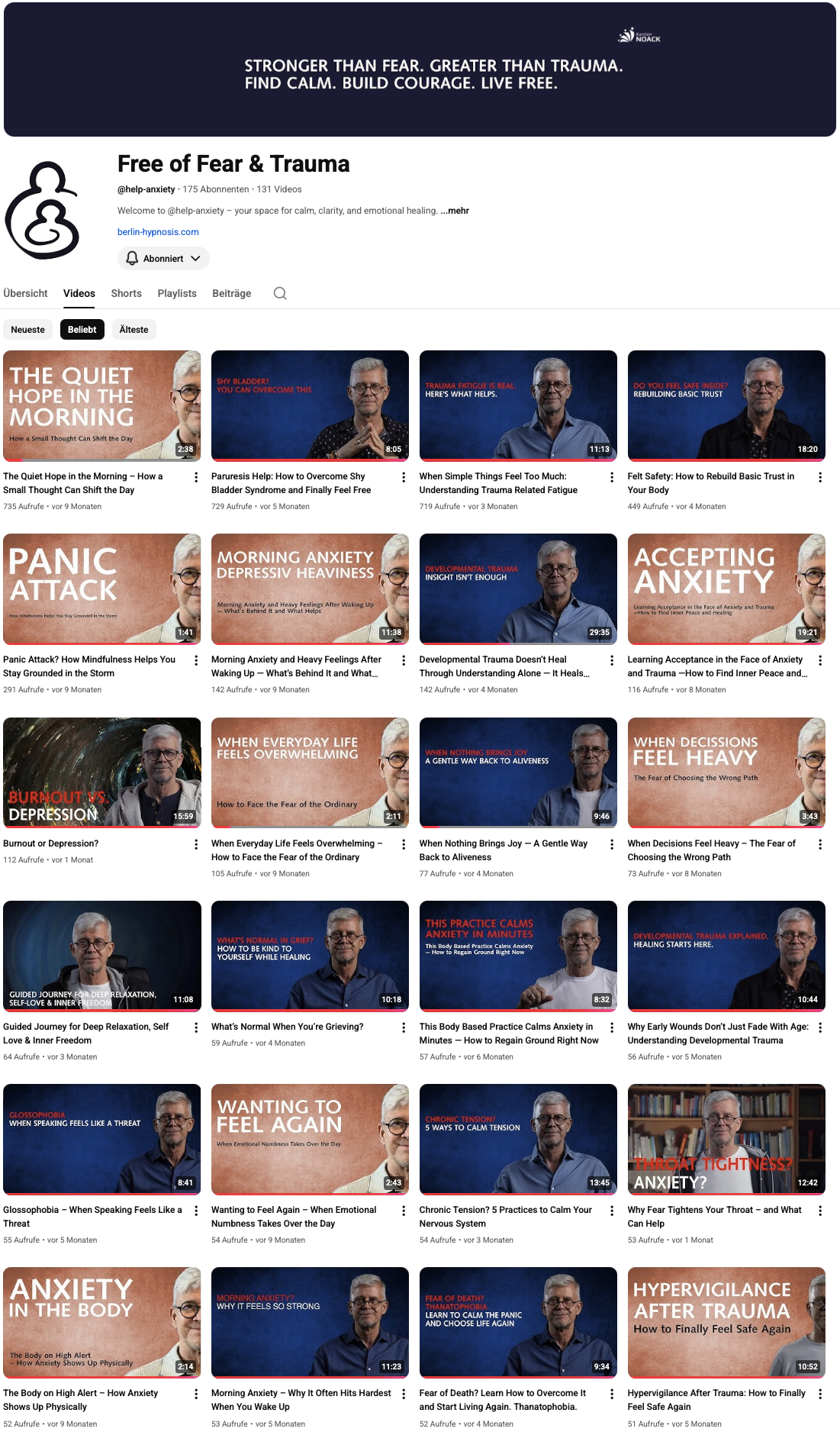
YouTube Channel
On my YouTube channel – Free of Fear & Trauma www.youtube.com/@help-anxiety – I regularly publish videos about anxiety, anxiety disorders, trauma and the effects of narcissistic abuse.
Please note: YouTube’s and Google’s privacy policies apply.
Step by Step
I’m gradually publishing content here—often based on the videos available on my German YouTube channel, www.youtube.com/@aengste.
If there’s a topic you’d like me to cover, feel free to let me know.
Published: March 1, 2008
Author: Karsten Noack
Revision: November 17th, 2025