
Trauma Therapy in Berlin & Online
Support for trauma, developmental trauma, complex trauma and trauma-related anxietySupport for trauma, developmental trauma, complex trauma and trauma-related anxiety
Trauma can affect far more than memories of what happened.
It can change how safe you feel in your body.
How quickly your nervous system reacts.
How close you allow other people to come.
How you respond to uncertainty, conflict, closeness or loss of control.
Sometimes the original experience lies years or decades in the past, while the body still reacts as though danger were close.
Therapy can help you understand these responses, develop greater inner safety and gradually regain freedom in everyday life.
I offer integrative psychotherapy for trauma-related difficulties in Berlin-Charlottenburg and online.
Trauma Can Take Many Forms
Some traumatic experiences are connected with a clearly identifiable event.
Others develop through repeated or prolonged experiences.
These may include:
- accidents
- medical experiences
- violence
- abuse
- emotional neglect
- physical neglect
- prolonged insecurity
- developmental trauma
- difficult childhood environments
- narcissistic abuse
- coercive relationships
- repeated experiences of helplessness
- repeated loss of control
- war
- displacement
- other overwhelming experiences
The decisive question is often less:
“Was this bad enough to count as trauma?”
A more helpful question can be:
“What effect did this experience have on me, and what is still happening inside me today?”
How Trauma May Show Up Later
Trauma-related responses can appear in very different ways.
You may experience:
- persistent inner tension
- hypervigilance
- sudden anxiety
- panic
- emotional numbness
- intrusive memories
- nightmares
- avoidance
- difficulties with trust
- strong reactions to seemingly small triggers
- dissociation
- feeling disconnected
- freezing
- shutting down
- difficulties setting boundaries
- chronic feelings of shame
- chronic feelings of guilt
- physical alarm reactions without an obvious current danger
Some people function extremely well outwardly while using enormous amounts of energy to stay composed internally.
That is one reason trauma can remain unseen for a long time.
Developmental and Complex Trauma
Trauma that develops early in life can influence more than individual memories.
It can shape expectations about safety, relationships, closeness, conflict and self-worth.
When difficult experiences continue over a longer period, people often develop ways of adapting that once helped them cope.
Later, these same patterns can become restrictive.
You may notice that you:
- scan other people constantly for signs of danger
- adapt quickly to avoid conflict
- struggle to sense your own needs
- feel responsible for other people’s emotions
- remain highly alert even in safe situations
- find calm strangely unfamiliar
- repeatedly enter relationships that recreate familiar dynamics
- find it difficult to trust your own perceptions
- lose contact with your own boundaries under pressure
Therapy can help these patterns become understandable.
And what becomes understandable can gradually become more flexible.
Trauma and Anxiety Often Overlap
Trauma and anxiety frequently interact.
A traumatic experience can leave the nervous system more sensitive to perceived threat.
This may contribute to:
- panic attacks
- health anxiety
- social anxiety
- avoidance
- fear of losing control
- persistent physical tension
- strong reactions to reminders of earlier experiences
- difficulties calming down after stress
For this reason, I often work with trauma and anxiety together.
In everyday life, these experiences rarely fit neatly into separate categories.
How I Work
My therapeutic work is integrative.
The method follows the person.
Depending on your situation, our work may include:
- therapeutic conversation
- reflection
- nervous-system regulation
- body awareness
- work with inner beliefs
- work with emotional patterns
- imagery
- resource-oriented approaches
- hypnotherapeutic methods
- Hypnobalancing™
- self-hypnosis
- gradual work with triggers
- work with avoidance
- strengthening self-regulation
- strengthening self-trust
The therapeutic process should fit your current stability, your goals and your individual pace.
Trauma Therapy Does Not Mean Reliving Everything
Many people worry that trauma therapy means repeatedly going through painful memories in detail.
Therapeutic work can begin somewhere else.
Often the first steps involve:
- developing orientation
- strengthening inner safety
- strengthening external safety
- understanding current reactions
- improving emotional regulation
- improving bodily regulation
- increasing your ability to stay present
- building resources
- strengthening self-efficacy
From there, deeper processing can become possible when it is useful and sufficiently supported.
The aim is to create enough stability for meaningful change.
The focus is on increasing your capacity to remain present, connected and able to act.
The Nervous System Matters
Trauma is often described as a psychological experience.
The body is deeply involved as well.
Your nervous system may continue to react long after a situation has ended.
You may understand intellectually that you are safe while your body still signals danger.
This can be confusing.
It can also become more understandable once we look at trauma as a pattern involving body, emotions, thoughts, memory and relationships.
Therapy can support you in gradually developing a greater sense of safety from the inside.
Calm Is More Than a Technique
Many people work very hard to control their reactions.
They breathe.
They distract themselves.
They analyse.
They change the way they think.
Sometimes these approaches help.
Sometimes the nervous system needs something deeper than another technique.
It may benefit from repeated experiences of safety, orientation, regulation and self-trust.
The goal is therefore broader than becoming calm.
The goal is greater flexibility.
You want to be able to notice what happens inside you and remain connected with yourself.
What Therapy Can Help You Develop
The aim of therapy is broader than reducing symptoms.
More inner safety
A greater ability to stay present when stress rises.
More self-trust
A clearer sense of what you feel, need and perceive.
More access to your boundaries
The ability to notice earlier when something feels wrong.
More freedom in triggering situations
Greater choice instead of automatic reactions.
More emotional flexibility
Greater access to feelings while maintaining stability and orientation.
More room for relationships
Closeness can gradually become more connected with safety, choice and self-respect.
More freedom in everyday life
Your past can remain part of your history without continuing to organize your present.
Hypnotherapy as Part of an Integrative Approach
Hypnotherapy can be a valuable part of trauma-informed therapeutic work.
It may support:
- access to inner resources
- emotional regulation
- body awareness
- self-soothing
- imagery
- strengthening inner safety
- working with automatic responses
- developing new internal experiences
Hypnosis is one therapeutic tool within a broader integrative process.
Your stability, orientation and ability to remain connected with yourself remain central.
Trauma and Relationships
Trauma often becomes visible in relationships.
You may notice that you:
- become very alert to changes in another person’s mood
- withdraw quickly
- adapt too much
- fear rejection strongly
- struggle with closeness
- struggle with distance
- find conflict unusually threatening
- remain in unhealthy dynamics for too long
- question your own perception
- feel responsible for keeping relationships emotionally stable
These reactions often have an inner logic.
They may once have helped you protect yourself.
Therapy can support you in developing new ways of relating while staying connected with yourself.
When Narcissistic Abuse Leaves Trauma-Related Patterns
Repeated manipulation, devaluation, gaslighting, emotional pressure or coercive control can have lasting effects.
People who have experienced narcissistic abuse often describe:
- self-doubt
- hypervigilance
- difficulties trusting their perception
- fear of conflict
- strong guilt
- difficulty saying no
- emotional exhaustion
- freezing under pressure
- persistent inner tension
- feeling responsible for the other person
Therapy can help restore orientation.
That includes learning to trust your own signals again, strengthening boundaries and developing greater inner stability.
Your Pace Matters
Trauma-related work benefits from a pace that supports stability.
The useful pace is the one that allows meaningful change while maintaining enough inner stability.
Therapy can therefore include phases of:
- stabilisation
- understanding
- emotional processing
- behavioural change
- integration
The sequence depends on your needs.
Trauma Therapy in Berlin and Online
Sessions are available in person in Berlin-Charlottenburg and online.
Online therapy can be especially useful if you:
- live outside Berlin
- travel frequently
- prefer working from your own environment
- want greater flexibility
- already feel comfortable with video sessions
In-person sessions may feel preferable if you value the direct presence of a shared therapeutic space.
Both formats can offer a useful setting for therapeutic work.
Your Therapist
My name is Karsten Noack.
Since 1998, I have worked therapeutically with people experiencing anxiety, anxiety disorders, trauma-related difficulties and emotional overwhelm.
My work combines extensive therapeutic experience with an integrative approach that includes hypnotherapeutic methods.
A central part of my work is helping people regain:
- orientation
- inner safety
- self-trust
- emotional flexibility
- the ability to act
Sessions are available in English and German.
Is Trauma Therapy Right for You?
You may want to consider therapy if you notice that earlier experiences still influence your present life.
For example:
- your body reacts strongly in safe situations
- certain triggers repeatedly overwhelm you
- relationships activate old patterns
- you freeze under pressure
- you remain constantly alert
- you feel disconnected from yourself
- you struggle to trust your own perception
- anxiety has become closely linked with past experiences
- your coping strategies require increasing effort
Therapy can offer a space to understand these reactions and develop new possibilities.
The Next Step
If you are considering therapy, send me a short message describing:
- what you are currently experiencing
- what you would like to change
- whether you prefer online sessions or sessions in Berlin
- your general availability
I read each request personally.
I will let you know whether your concern fits my therapeutic focus and what a suitable next step may be.
Just ask me personally.
Let's talk. Please read the privacy policy. If you are interested, you can contact me for questions and appointments via this contact form or by e-mail (mail@berlin-hypnosis.com). Make sure I understand what you are asking for.
You can find answers to frequently asked questions, such as fees, on the home page. There are also lots of articles and details about me (profile) to help you get an idea of who I am. This will also make it easier for you to decide if I am the right therapist for you and your problem.
Message
Remarks:
In the address bar of your browser, the URL should begin with "https://www.berlin-hypnosis.com/...". This indicates a secure connection (SSL). Whether you enter your real name is up to you.
Important Information Before Contacting Me
Read This First
Before reaching out, please take the time to review the detailed information on the following topics:
- Fees and Booking Procedures
- Contraindications for Hypnotherapy
- Answers to Frequently Asked Questions (FAQ)
About This Page
This page is designed to provide essential information for individuals interested in psychotherapy through hypnotherapy. However, it is not intended to replace professional psychotherapy, medical consultations, examinations, or diagnoses by a licensed medical practitioner.
My Role and Expertise
I am a hypnotherapist licensed to practice psychotherapy under the HPG (Heilpraktikergesetz). My work focuses on helping people manage anxiety, anxiety disorders and trauma. It is important to note the following distinctions:
- I am not a medical doctor.
- I do not provide medical diagnoses, prescribe medications, or make promises of healing.
- Psychotherapy with hypnotherapy is not a substitute for medical or psychiatric care where such intervention is necessary.
Contact Me
If you have any questions about psychotherapy with hypnotherapy, feel free to reach out. I am happy to provide more information and guide you on how hypnotherapy can support your journey to improved well-being.
YouTube Channel
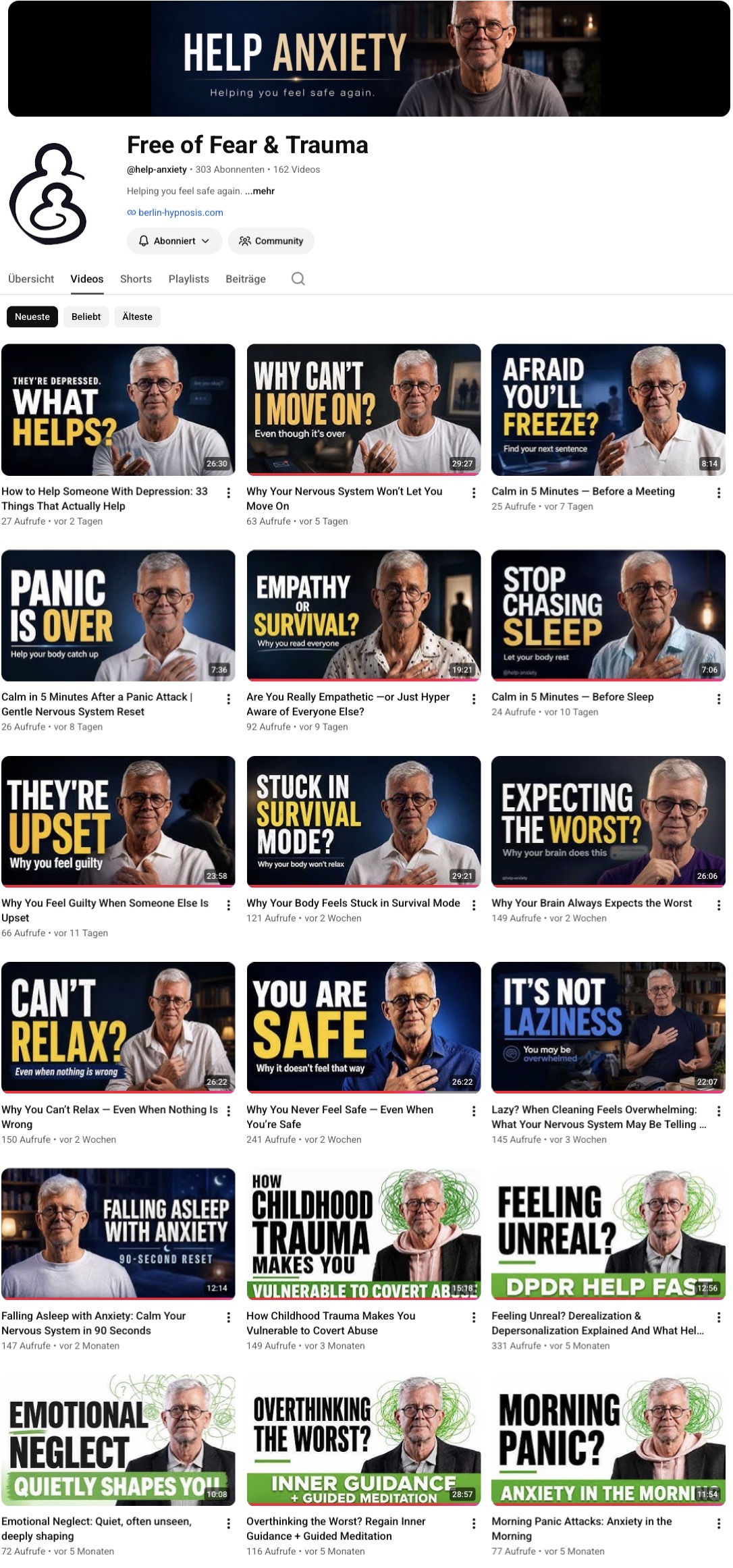
On my YouTube channel – Free of Fear & Trauma www.youtube.com/@help-anxiety – I regularly publish videos about anxiety, anxiety disorders, trauma and the effects of narcissistic abuse.
Please note: YouTube’s and Google’s privacy policies apply.
Step by Step
I’m gradually publishing content here—often based on the videos available on my German YouTube channel, www.youtube.com/@aengste.
If there’s a topic you’d like me to cover, feel free to let me know.
Published: March 1, 2008
Author: Karsten Noack
Revision: November 17th, 2026